
Montgomery Parole and Probation
Parole generally begins after a person leaves prison under a grant from the Mississippi State Parole Board. Probation comes from a court sentence and may take the place of confinement or follow a suspended part of a term. A person released on bond may have neither status. The legal source matters because a Montgomery County booking record from the sheriff only explains the custody exit. It does not, by itself, establish who supervises the person afterward.
Mississippi also uses Earned Release Supervision, or ERS. An eligible person may live in the community while remaining under MDOC jurisdiction through the sentence term. House arrest, also called the Intensive Supervision Program, is judge-ordered. MDOC states that it has not had independent power to place someone on house arrest since July 2014. These paths all involve community oversight, but they arise from different legal acts and should not be merged into one label.
| Status | How it begins | Best verification source |
|---|---|---|
| Parole | Board grant after prison confinement | MDOC Parolee Search, Board record, and MDOC Records |
| Probation | Court order, with or without a suspended term | Sentencing court file and Community Corrections |
| ERS | Statutory earned-release framework for eligible MDOC sentences | MDOC computation and Community Corrections record |
| Discharge | Supervision term has lawfully ended | Final discharge record from the responsible agency or court |
Verify Montgomery Post-Release Supervision
The MDOC Parolee Search is the main online path for a state prisoner who entered the community on parole. It accepts name or MDOC ID criteria and provides city and county filters. An MDOC ID is the strongest search key. When only a name is known, compare every visible identifier before treating the record as a match. The search is not a complete historical discharge index, and a no-result screen cannot settle a person's past status.
Use a custody-specific sequence. It avoids a common error: searching a prison interface for a probation-only court case or treating the absence of a parole record as proof that someone is still confined.
- Collect the full legal name, MDOC ID if known, date of birth, court case number, and last known agency. Keep identifiers private unless an office needs them.
- Search the parolee system by MDOC ID or name. Use the city or county filters only after checking spelling and identity details.
- If parole is not the likely status, obtain the sentencing order through the proper office on the Montgomery County courts page. The order should show whether probation or a suspended sentence was imposed.
- Contact the Carroll/Montgomery office and ask whether it is the reporting office for a matched person and what status information may be disclosed.
- For an actual release date, time sheet, or completed supervision record, contact MDOC Records. Do not turn a search absence into a discharge date.
The public MDOC Inmate Search serves a different phase. It is chiefly a custody source. A parolee-search match can corroborate that a person left prison for parole even when the inmate-oriented result is absent or unclear. Conversely, a county detainee released after dismissal, time served, or bond may never have an MDOC inmate record.
The official MDOC parolee form shows the exact fields available for a Montgomery County post-release supervision lookup.
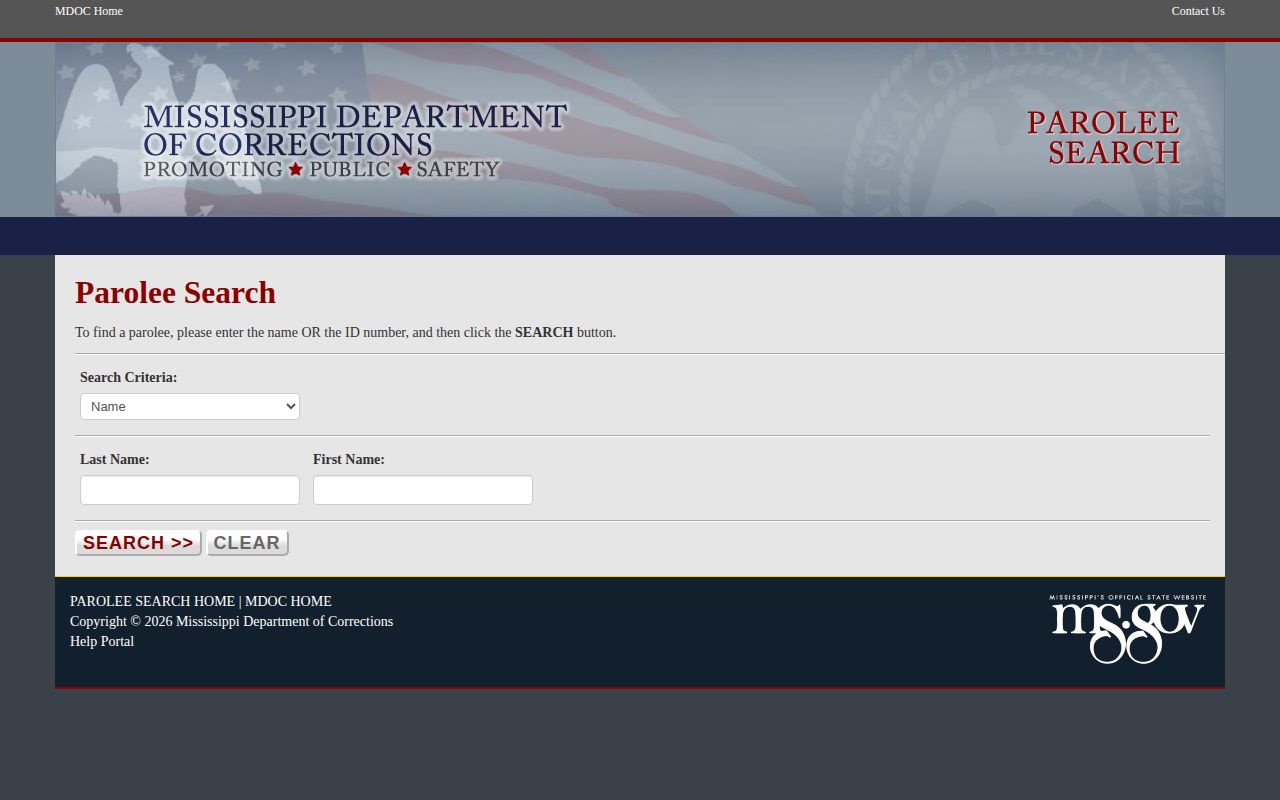
The screen supports a narrow person-specific search, while agency and court records supply the missing legal context.
Note: Record the date of each check because public supervision results can change as a case moves toward discharge.
Montgomery Supervision Office in Winona
Montgomery County has a named local route through the Carroll/Montgomery Probation & Parole Office. It is an MDOC Community Corrections office, not a jail, release list, or records archive. Staff may confirm the reporting office and the information that can be disclosed for a matched individual. The official page names Tony P. Harris as Community Corrections Director. No office hours are published in the research, so call before visiting.
Carroll/Montgomery Probation & Parole
108 North Applegate Street
Winona, MS 38967
Mail: P.O. Box 72
Phone: 662-226-5419
Fax: 662-226-8355
Use the office after making an identity match. Ask whether the person reports there, whether the disclosed status is parole, probation, or ERS, and which agency holds the final record. The office should not be asked for a county-wide release log. It also cannot substitute for the sentencing court when the issue is the wording of a probation order.
The MDOC office page gives a visual check on the name and local contact details.
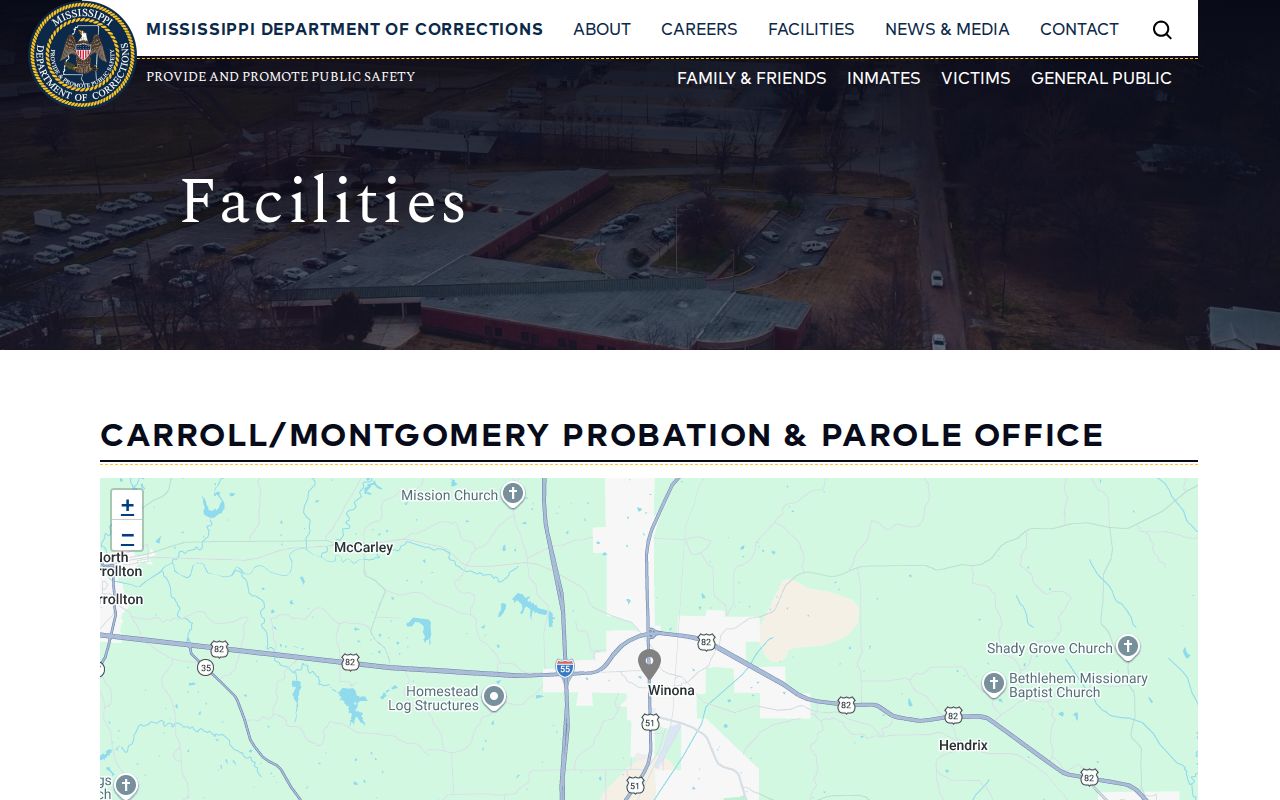
That official listing is the best place to confirm that the shared office remains current before relying on saved contact details.
Why the Montgomery Office Says Carroll
The local office has a useful but confusing detail. Its official title covers Carroll and Montgomery, and its street address is in Winona. Yet the page's County field says “Carroll.” That metadata quirk does not mean Montgomery County lacks a local supervision route. Readers who search only for a Montgomery-labeled office may miss the correct result.
Preserve the full office title when calling or writing. Give the person's MDOC ID, court case number, and the county tied to the sentence when those details are known. Ask staff to confirm the correct reporting unit rather than assuming the County field controls an individual assignment. The named shared office is strong evidence of the local service path, but a person may have moved or been assigned elsewhere. Current agency confirmation resolves that issue.
Montgomery Supervision Events and Violations
Conditions are the rules attached to community supervision. Their exact terms come from the court, Parole Board, or MDOC record. A violation allegation may lead to added review, a warrant, or revocation, which means supervision is withdrawn and custody may resume. An absconder is a person alleged to have stopped reporting or whose location is unknown. The label is not the same as a final revocation or discharge.
Mississippi SAVIN/VINE can issue events for return to custody after absconding and escape or abscond-supervision changes. Its alerts are driven by participating agency systems, so they are fast notice rather than a certified finding. Registration help is available at 601-359-5759 during business hours or at 888-967-7284 around the clock in English and Spanish. No official Montgomery County sheriff absconder or warrant list was found. Confirm a warrant, revocation, or return to custody through MDOC, the Parole Board, the responsible court, or the office that created the record.
- Eligibility
- The point when a case may be considered for parole, not a promise of release.
- Revocation
- An official act ending community supervision and potentially returning the person to custody.
- Absconder
- A person alleged to have stopped complying or whose location cannot be established.
- Discharge
- The lawful end of a sentence or supervision term.
Note: A stale alert or unmatched name should never be used alone to describe a current Montgomery County supervision status.
Montgomery Parole Decisions and Records
The Mississippi State Parole Board rules assign the Board power to grant and revoke parole, while MDOC computes eligibility and supervises parolees. Hearings are closed to the public. No official public hearing calendar or searchable results database was found. Eligibility only opens consideration. It is not a hearing result, tentative release date, parole grant, or physical exit from custody.
Board rules require a minute-book record of official action and reasons. Decisions go to the offender, and written notice may go to a victim or family member as provided by the rules. Other disclosures are case-specific and may be limited for safety, confidential-source, or reentry reasons. A focused request can ask the Board at 239 North Lamar Street, Suite 501, Jackson, MS 39202, 601-576-3520, or MSStateParoleBoard@mdoc.state.ms.us about a decision or minute to the extent disclosable. Inmate-record requests route through MDOC GovQA.
For a clean chain, separate four facts: the eligibility calculation, the hearing or decision, the community supervision record, and the actual release event. If the key question is when custody ended, the full release-record path is explained on the Montgomery County released inmates home page. A Board grant alone does not provide the gate time, and a court order may still require processing and a check for other holds.
Note: Miss. Code §§47-7-3 and 47-7-3.2 govern parole eligibility categories and thresholds; eligibility never proves that a Montgomery County release occurred.
Confirm Montgomery Supervision Discharge
Supervision ends through an official discharge or another final agency or court action. A person may stop appearing in the parolee search because parole ended, the name no longer matches, the public system changed, or the person is on a different status. None of those possibilities should be selected from absence alone. Ask MDOC Records for the supervision and discharge record when a definitive historical statement is needed.
MDOC Records can be reached at P.O. Box 24388, Jackson, MS 39225, by phone at 601-933-2889, or at MDOCRecordsDepartment@mdoc.state.ms.us. A focused request should include the MDOC ID, name, relevant sentence or cause number, and the exact fact in dispute. Ask for the actual release or discharge date and type, supervision status, and time sheet when those records apply.
Probation discharge may also require the sentencing court file. Compare the final order with MDOC or Community Corrections information rather than averaging conflicting dates. One may mark the end of custody, another the start of supervision, and another the end of the sentence. Preserving each label produces a more accurate result.